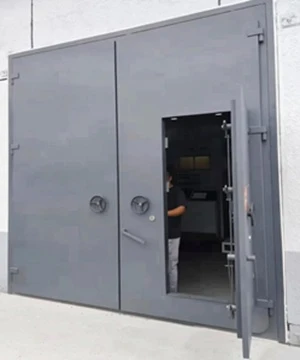

Differences between Normally Open Fire Doors and Normally Closed Fire Doors
Fire doors are originally designed to stay closed to block fire and smoke. However, busy main passages see constant foot traffic, wheelchairs, trolleys and goods passing through, requiring manual opening and closing each time. Heavy peak-hour traffic causes congestion and fatigue. Many people prop fire doors open with blocks or trolleys for convenience. This improper practice deforms and damages door closers and latches. In case of fire, the door cannot close automatically, losing its function of fire/smoke separation and fire zone compartmentation, creating severe hazards and defeating the purpose of fire protection.
Normally open fire doors balance safety and accessibility. Fitted with electromagnetic releases, automatic door closers and sequence closers, they operate under fire control. Under normal conditions, the doors are held open without blocking passage, enabling smooth movement of people and equipment. It eliminates the common violation of propping doors open, ideal for high-traffic wide passages and improves convenience in public areas.
In terms of fire safety, normally open fire doors fully comply with Code for Fire Protection Design of Buildings and Code for Design of Automatic Fire Alarm System, with undiminished fire resistance. When a fire breaks out, smoke and heat detectors transmit fire signals to the fire control host. The host triggers the electromagnetic release to trip. The held-open fire door then closes automatically and smoothly under the action of the door closer. For double-leaf doors, the sequence controller ensures sequential, tight closure. This effectively stops fire spread and smoke propagation, compartmentalizes fire zones and protects escape routes. The door closing signal is fed back to the fire control room in real time for on-site status monitoring, providing comprehensive building fire safety protection.

Application Scenarios of Normally Open Fire Doors

Normally open fire doors are not universally applicable. Application sites must be carefully selected to avoid arbitrary modification. They are primarily used in high-traffic main passages such as shopping malls and supermarkets, corridors of hospital outpatient and inpatient buildings, public walkways in school teaching buildings, large stadiums, exhibition centers and main personnel passages in industrial parks.
For critical emergency escape areas including building stairwells and smoke-proof anterooms, codes mandate the use of normally closed fire doors. Conversion to normally open type without authorization is strictly prohibited, to prevent backflow of fire and smoke and blockage of escape routes during fires.