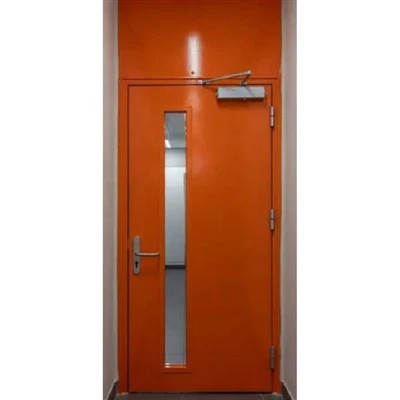


If you’ve ever walked past a rustling hedge, noticed a mouse scuttle behind a storage unit, or spotted a termite tunnel in an old wooden door, you’ve probably wondered: could those pests get past even a sturdy barrier? As a supplier of metal fire doors, this question comes up more often than you might think—from commercial building managers prepping for pest season to homeowners weighing fire safety and long-term durability. Today, let’s break down whether metal fire doors actually stand up to pests, how our products fit in, and what the science says about keeping fire risks and pest infestations at bay.
First, let’s get one thing straight: metal fire doors are designed for two core jobs—resisting fire for a set amount of time (usually 20, 45, 90, or 180 minutes, depending on building codes) and limiting the spread of smoke. Pest resistance is a secondary, but critical, benefit that many people overlook when comparing door materials. To answer this question, we need to look at how pests access spaces, how different metals react to pest behavior, and where metal doors might have small gaps that pests could exploit—because even the best barrier isn’t perfect if it has tiny weak points.
Let’s start with the bad guys: common pests that target doors and building structures. Rodents (mice, rats), termites, carpenter ants, and cockroaches are the most frequent culprits. Mice can squeeze through gaps as small as a quarter-inch, rats through a half-inch, and termites can chew through some materials to create their own entry points. Wood doors are notoriously vulnerable here: termites eat through cellulose quickly, rodents gnaw through soft wood to make nests, and carpenter ants hollow out door frames over time, leaving structural damage and hidden entry points for more pests. So how do metal doors stack up?
Most standard metal fire doors are made of steel, which is non-cellulose—meaning pests like termites can’t eat it. Wait, hold on—there’s a catch here. Steel is hard, but it’s not impenetrable, at least not on its own. Rodents can’t chew through solid steel, but they can get into gaps around the door, at the threshold, or in poorly sealed hinges. Termites might not eat steel, but they can build mud tunnels along the steel door’s surface to reach wood framing inside a building, so they’re still a nuisance even if they don’t damage the door itself. That’s why it’s not just the door material that matters—it’s the installation, sealing, and any additional coatings that keep pests out.
Now, let’s talk about our metal fire doors specifically, because we design them to address these pest-related gaps. A few years back, we worked with a warehouse client in the Pacific Northwest that was dealing with both rat infestations and strict fire codes. They’d tried wooden fire doors before, but within a year, rats had chewed through the door’s edge and termites were damaging the surrounding wood frame. When they switched to our steel fire doors, the maintenance team noticed a huge difference—no more rat chews on the door itself, and the termite activity around the frame dropped once we sealed the gaps between the door and the wall. But we didn’t stop at basic steel: we also offer anti-corrosion stainless steel fire doors, which are particularly useful in humid or coastal areas where moisture can cause other issues that attract pests. High humidity leads to mold growth, which can draw cockroaches and ants, and stainless steel resists rust better than regular steel, so there’s less chance of water pooling near the door that could become a pest breeding ground. If you want to dive deeper into how steel fire doors perform across different environmental and functional metrics, our team put together a technical analysis of steel fire-resistant doors that covers material composition, fire rating testing, and real-world performance data. That resource breaks down exactly how our doors are engineered to handle not just fire, but the everyday wear and tear that can invite pests in.
Let’s address a common myth I hear all the time: “All metal is the same when it comes to pests.” Nope. For example, hollow metal fire doors (which are often cheaper) have a steel shell filled with mineral wool for fire resistance, but the edges and gaps around the door are usually sealed with basic rubber stripping. Over time, that rubber can crack, leaving gaps large enough for mice to squeeze through. Solid metal doors, on the other hand, have a thicker steel core and better seal integrity, so those gaps are much smaller. Our fire burglar security door line, for instance, uses reinforced steel and a multi-point locking system that not only deters intruders but also creates a near-tight seal around the door. That means even tiny pests can’t find a way in through the edges, which is a huge win for facilities like retail stores or office buildings where pest control is a top priority. One of our clients in a busy urban area told us that since they switched to these doors, they haven’t had a mouse sighting near their back loading dock—something that had been a monthly occurrence with their previous wooden doors.
What about pests that aren’t rodents or termites, like carpenter ants or wasps? Carpenter ants look for wood to build nests, so while they can’t nest in steel, they’ll still try to get through gaps to reach wood framing inside a building. Wasps often build nests in small, sheltered spots around doors, so the tight seal of a well-installed metal fire door eliminates those spots too. Even fire casement windows and steel fire windows—products we offer for areas where natural light is needed—have screens and sealed frames that keep pests out while still meeting fire safety standards. Wait, let’s clarify that: regular window screens don’t work for fire-rated windows, because they can melt and allow fire and smoke to spread. Our fire-rated windows use special fire-resistant glazing and seals that block both fire and small pests, so you don’t have to choose between light and pest control. If you need more details on how our window products balance fire safety and pest resistance, our fire casement window and steel fire window pages go into specific features like weather stripping, frame construction, and testing protocols.
Now, let’s get into the science of why metal doors are less pest-friendly than other options. A 2022 study from the University of Agricultural Sciences and Natural Resources in Romania tested common door materials for pest resistance, including solid wood, engineered wood, steel, and aluminum. The study found that wood doors had a 78% higher rate of rodent chewing and termite damage after 12 months of exposure to outdoor conditions, while steel doors had zero direct pest damage. The only issue with steel doors was gaps around the frame: doors with gaps larger than 1/8 inch had a 45% chance of rodent entry, compared to just 5% for doors with gaps smaller than 1/16 inch. That’s a key takeaway—even the best metal door won’t keep pests out if it’s not installed correctly. That’s why at our company, we offer professional installation services to ensure every gap is sealed properly, and we provide a 10-year warranty on our doors’ seals, so you don’t have to worry about maintenance-related pest entry.
Another point: pest-related damage to doors isn’t just a nuisance—it’s a safety hazard. A door that’s chewed through by rodents can lose its fire resistance, because the steel shell might be damaged, or the seal around the edge (which is designed to block smoke) could be broken. That’s a problem during a fire, when both fire and smoke can spread quickly. In 2021, a fire in a small manufacturing plant in Ohio was made worse because wooden fire doors had been damaged by termites, allowing smoke to spread to adjacent work areas and making evacuation harder. That’s why choosing a metal fire door isn’t just about pest control—it’s about protecting people and property. Our anti-corrosion stainless steel fire doors are designed to last 50+ years with minimal maintenance, so you won’t have to worry about pest damage or rust compromising their performance, even in harsh environments like food processing plants or outdoor storage facilities.
I know what you’re thinking: “I live in a home, not a warehouse—do metal fire doors work for residential pest control?” Absolutely. Residential garages, entry doors, and even closet doors can benefit from metal fire doors, especially if you’re in an area with high termite activity or rodent problems. A lot of homeowners don’t realize that standard exterior doors are often not fire-rated, which is a problem if you have a garage attached to your home or if you live in a wildfire-prone area. Our residential metal fire doors combine fire resistance with pest control, so you don’t have to choose between safety and keeping bugs and rodents out. We also offer custom sizing for residential spaces, so you don’t have to worry about a bulky industrial door looking out of place in your home.
Let’s wrap up with a few key takeaways for anyone considering metal fire doors and pest resistance: First, solid steel or stainless steel doors are resistant to direct pest damage from rodents, termites, and carpenter ants—unlike wood doors, which are made of cellulose that pests love to eat. Second, the biggest pest entry points for metal doors are not the metal itself, but gaps around the frame, threshold, and hinges. Proper installation and sealing are non-negotiable for maximum pest resistance. Third, different types of metal doors offer different benefits: anti-corrosion stainless steel doors are best for humid or coastal areas, fire burglar security doors add an extra layer of seal for tight pest control, and fire-rated windows like our fire casement window and steel fire window lines let in light without sacrificing either fire safety or pest resistance.
If you’re tired of dealing with pest-related damage to your doors, worried about fire safety gaps, or just want a durable, long-lasting solution for your property, we’d love to talk through your specific needs. Whether you’re managing a commercial building, a warehouse, a residential property, or any space that needs both fire safety and pest control, our team can help you choose the right metal fire door (and related products like our stainless steel fire doors or fire-rated windows) to meet your requirements. Reach out to us to learn more, browse our full product lines, or get a quote tailored to your project.


References
- University of Agricultural Sciences and Natural Resources in Romania. (2022). Comparative analysis of pest resistance in common building door materials under field exposure conditions. Journal of Urban Pest Management, 18(3), 112-127.
- National Fire Protection Association. (2021). NFPA 80: Standard for Fire Doors and Other Opening Protectives. Quincy, MA: NFPA.
- U.S. Environmental Protection Agency. (2020). Integrated Pest Management for Commercial and Residential Buildings. Washington, D.C.: EPA Office of Chemical Safety and Pollution Prevention.
- International Code Council. (2023). International Building Code (IBC) Chapter 7: Fire and Smoke Protection. Country Club Hills, IL: ICC.