
Fire-rated window
Fire windows are classified by fire resistance performance into Category A insulated fire windows, Category B partially insulated fire windows and Category C non-insulated fire-resistant windows. This is the core classification standard for fire acceptance.
Category A Insulated Fire Windows: Meet both fire integrity and thermal insulation requirements, namely Class A, B and C fire windows. Class A1.5 (≥90min), Class A1.0 (≥60min), Class A0.5 (≥30min). They block flame penetration and limit temperature rise on the non-fire side to prevent ignition of combustibles. Applied to fire walls, indoor fire partitions and stairwells. Steel profiles are preferred for high fire resistance grades.
Category B Partially Insulated Fire Windows: Only 30-minute thermal insulation with longer fire integrity. Rarely adopted in projects.
Category C Non-insulated Fire-resistant Windows: Known as fire-resistant windows in the industry. Only fire integrity is required without mandatory thermal insulation. The sash stays intact to prevent flame spread, while temperature rises on the non-fire side. Widely used for external walls of high-rise residential buildings and factories. Most broken-bridge aluminum fire-resistant windows fall into this category.

Classified by frame base material

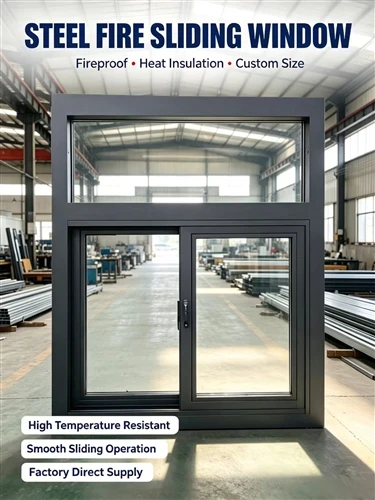
Steel fire windows: The frame and sash are made of Q235 galvanized cold-rolled steel sheets with plate thickness complying with national standards. The cavity is filled with fire-resistant materials and fitted with fire intumescent sealing strips. Steel features low thermal deformation under fire, excellent fire stability, wind resistance and impact resistance. It can achieve Category A insulated high fire resistance with moderate cost, widely used in factories, warehouses, boiler rooms, power distribution rooms and other industrial buildings. 304 stainless steel versions are available for humid and corrosive environments such as chemical plants and sewage facilities.
Broken-bridge aluminum fire-resistant windows: Constructed with broken-bridge aluminum profiles. Fire integrity is achieved by adding steel liners and filling inorganic fire-resistant materials inside cavities together with fire fittings. Its advantages include attractive appearance, good air tightness, water tightness and thermal insulation, plus a wide range of color options. It is commonly used for external facades of residential buildings, office buildings and commercial complexes. The drawback is that aluminum tends to soften at high temperatures; most products are only Category C non-insulated type. Not recommended for large openings or high wind pressure conditions.
Fixed fire window: The sash is fixed and non-openable. It has a simple structure and high stability, and its fire resistance performance is easier to guarantee. It is mostly used for wall openings requiring only fire separation without ventilation.
Operable fire window: The sash can be normally opened for ventilation and must be equipped with a temperature-controlled window closer. In case of fire, when the temperature reaches the threshold, the fusible device activates, and the sash automatically closes and locks to maintain fire separation. This is the most common type for building external facades. Acceptance focuses on inspection of temperature-controlled window closers and 3C certificates; certificate parameters must match the on-site products.