
Steel Fire Curtain Anti‑deformation Structure

Curtain Slat Anti-
deformation Structure
For large-span curtain surface, gradient plate thickness design is adopted: thicker at mid-span and thinner at both sides. Slats are interlocked and overlapped with tiny rotational clearance to ensure smooth rolling and prevent lateral dislocation. Thermal expansion gaps are reserved on slats to release thermal expansion stress under high temperature and avoid arching and buckling.
01
Guide Rail and Anchoring Anti-deformation Structure
Guide rails are fixed to the building structure via densely arranged adjustable steel brackets, anchored by expansion bolts or embedded steel plates to improve pull-out and lateral resistance and prevent outward tilting and displacement of guide rails. The verticality of guide rails can be adjusted on site to eliminate additional stress caused by installation deviation and avoid jamming and deformation.
02
Middle Wind-resistant Support
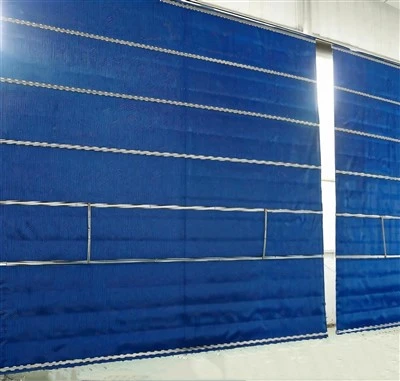
Middle wind-resistant ribs are installed for large door openings. Normally, the ribs are rolled onto the drum together with the curtain. When the curtain fully deploys in fire scenarios, the ribs automatically unfold and lock, laterally supporting the curtain surface, sharing wind pressure load, reducing mid-span deflection and controlling sealing gaps. The wind-resistant ribs are hinged to slats, balancing supporting rigidity and lifting flexibility.
03
Bottom Sill Plate Anti-deformation Structure
The bottom sill plate adopts an integrated heavy-gauge steel profile. It compresses the curtain surface by its dead load to restrain mid-span sagging and wavy warpage of the curtain slats under wind pressure, ensuring reliable tight contact between the curtain bottom edge and the floor surface. Limit sliders are installed at both ends of the sill plate to restrict horizontal shifting and avoid rail jamming during curtain lifting and lowering.
04
Application Scenarios of Steel Fire Shutters
Large-span steel fire shutters feature a large span, high structural rigidity, wind pressure resistance, deformation resistance and stable fire integrity. Suitable for fire separation of large openings under high wind pressure and heavy-load industrial conditions, they differ from inorganic fabric fire shutters and are preferred for sites subject to wind pressure, impact, dust and humidity. Their main application scenarios are as follows:
Large industrial plants and warehousing & logistics parks
01
Atriums and oversized shop openings in large commercial complexes
02
Large exhibition centers, stadiums and transportation hubs
03
Large underground parking garages and auxiliary machine rooms of underground utility tunnels
04
Supporting buildings for heavy industries such as power plants, chemical plants and metallurgical facilities
05