
Application and Performance of Steel Fire Doors
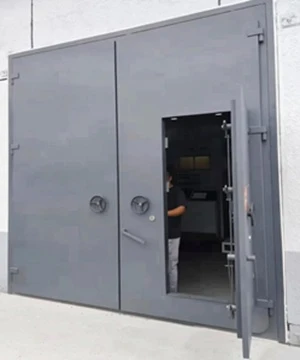
Steel fire doors are classified into three fire resistance grades: Grade A, Grade B and Grade C for different fire protection scenarios. Grade A offers a fire resistance rating of 1.5 hours, applied to high-risk fire compartments such as power distribution rooms, fire pump houses and equipment machine rooms. Grade B with a 1.0-hour fire resistance limit is mainly installed in stairwells, anterooms and evacuation passages to ensure safe personnel evacuation. Grade C has a 0.5-hour fire endurance, mostly used for sealing vertical shafts including pipeline shafts and weak current shafts to prevent vertical spread of fire and smoke.
All grades are equipped with fire-rated closers, door coordinators, fire locks and high-temperature resistant hinges. The full set of hardware features fire resistance and thermal deformation resistance, ensuring no malfunction or jamming under fire conditions.
Steel fire doors have remarkable advantages over wooden fire doors. Steel is non-combustible, high-temperature resistant, impact-resistant and dimensionally stable. It will not suffer from damp cracking, moth infestation or aging during long-term service, making it suitable for humid underground spaces, high-footfall public buildings and corrosive industrial environments. The surface electrostatic powder coating provides excellent anti-corrosion, wear-resistant and decorative performance, compatible with various fine decoration and commercial construction projects.

Key Technical Points of Fire Doors
Measured on-site with a vernier caliper, plate thickness check is the most common inspection item to detect thickness reduction by manufacturers. Hot-dip galvanized steel sheet is preferred with a galvanized coating weight of no less than 80 g/m². Ordinary cold-rolled steel plates shall not be adopted in coastal high salt-spray environments and damp underground spaces, so as to prevent early-stage rusting, hinge jamming and door leaf malfunction.
The thickness of hinge reinforcing backing plates shall be no less than 3.0 mm, and lock reinforcing liners shall also reach ≥3.0 mm, which prevents door leaf sagging and deformation after long-term operation. The inner part of the door leaf adopts fully welded well-shaped keel reinforcement structure. Extra vertical and horizontal stiffeners must be added for oversized double-leaf doors to avoid bulging, warping and deformation of door leaves under high fire temperature.

(II) Internal Fireproof Core Material

It is the core factor determining fire resistance and also a high-risk link for cutting corners in the industry. Qualified filling materials: high-density perlite fireproof board (density ≥300 kg/m³) and integrally pressure-poured aluminum silicate wool. The filling is fully compacted without internal cavities, avoiding collapse and rapid heat conduction under fire. The integral pouring process outperforms block filling and thoroughly eliminates hollowing inside door leaves.
Prohibited filling materials: honeycomb paper, ordinary rock wool, foam boards and waste cardboard. These materials will carbonize and burn through rapidly under high temperature, resulting in complete failure of fire resistance performance.
Simple acceptance inspection method: tapping the door leaf produces a dull solid sound for qualified filling; hollow echo usually indicates inferior core material replacement. Random destructive sampling test clauses can be stipulated in the contract.